

Young disabled people are constantly being told to toughen up. To get on with it. To stop making excuses. To accept that the working world is competitive and that nobody is going to make life easy for them.
And if they struggle to get into employment? Well, they must be lazy, entitled or simply unwilling to put the effort in.
Funny how the conversation so often focuses on what disabled people should be doing differently, rather than asking what employers, workplaces and society could be doing to make employment accessible in the first place.
Because sorry, but why should discrimination, inaccessible workplaces and a lack of reasonable adjustments just be accepted as part of becoming an adult?
Young disabled people aren’t simply refusing to work
There is a rather uncomfortable reality behind the conversations about young people who aren’t in education, employment or training: disabled young people are disproportionately represented in those figures.
The Department for Work and Pensions’ 2026 employment statistics paint a pretty stark picture.
- 30.2% of disabled people aged 16–24 were not in education, employment or training, compared with 8.6% of non-disabled young people.
- 45.3% of young people aged 16–24 who were NEET were classed as disabled.
- 59.3% of disabled young people who were NEET identified disability or ill health as their main reason.
- Between 2014 and 2025, an average of 16.7% of disabled young people who were NEET moved into employment each year, compared with 45% of non-disabled young people.
Those numbers deserve more than a passing mention. They should make us question why so many young disabled people are struggling to access the same opportunities as their non-disabled peers.
Instead, the conversation so often turns into a lecture about work ethic.
Of course, not every disabled person is able to work, and not everyone wants to. But for those who do want to work, there is a difference between being unwilling to participate and being repeatedly confronted with barriers that make participation harder.
And that difference matters.

“Welcome to the real world.” Oh, do give it a rest.
We’ve all heard the phrases.
- “Welcome to the real world.”
- “It’s a dog-eat-dog world.”
- “You need to toughen up.”
- “Nobody is going to make exceptions for you.”
- “That’s just how workplaces are.”
They’re usually delivered as if someone has just shared a profound piece of wisdom. In reality, they’re often used to shut down perfectly reasonable conversations about discrimination, accessibility and basic fairness.
Let’s get one thing straight: being an adult does not mean accepting mistreatment without question.
Being employed does not mean you should have to tolerate discrimination. Having a disability does not mean you should be grateful for whatever scraps of opportunity an employer decides to offer. And having additional needs does not make you unreasonable for asking for adjustments that allow you to do your job.
There is a difference between understanding that work can be challenging and being expected to accept barriers that shouldn’t exist in the first place.
A demanding job is one thing. A workplace that refuses to make reasonable adjustments is another.
Calling both of those things “the real world” doesn’t magically make them the same.
When did basic workplace accessibility become a luxury?
Reasonable adjustments aren’t special treatment. They’re a way of removing or reducing disadvantages that disabled people may face in the workplace.
Depending on the individual and the role, adjustments might include flexible working arrangements, adapted equipment, changes to working hours, accessible software, additional breaks, a quieter working environment or a different way of completing certain tasks.
None of that means an employer has to make every possible change regardless of circumstances. But under the Equality Act 2010, employers have a legal duty to make reasonable adjustments for disabled workers in qualifying circumstances.
You can read more about disability rights and reasonable adjustments at work.
And yet, disabled people still encounter workplaces where asking for adjustments is treated as an inconvenience, an unreasonable demand or a sign that they aren’t suited to the job.
Imagine being told you’re not a good fit for a workplace because you need that workplace to be accessible. The irony practically writes itself.
Accessibility shouldn’t depend on whether an employer happens to be particularly understanding that day. It shouldn’t be treated as a generous favour, either. It’s part of creating a fair working environment.

Disabled people shouldn’t have to prove they’re worth accommodating
One of the most exhausting parts of navigating employment with a disability can be the expectation that you must continually justify your needs.
Explain your condition. Explain your limitations. Explain why you need an adjustment. Explain why the adjustment matters. Then, sometimes, explain it all over again to someone else.
It can feel as though the responsibility is always on the disabled person to convince everyone else that their needs are legitimate.
And there’s another problem: disability isn’t always visible, consistent or predictable.
Someone might be able to work a particular schedule one week and struggle with it the next. Someone might be capable of doing a job but need flexibility around how and when they complete certain tasks. Someone might be perfectly capable of contributing to a team while finding a traditional nine-to-five environment inaccessible.
That doesn’t make someone unreliable, lazy or incapable. It means people have different needs, and a one-size-fits-all approach to employment doesn’t work for everyone.
We shouldn’t have to fit ourselves into an inaccessible system and then be criticised when it doesn’t work.
I’m not asking for the world to revolve around me
This is personal to me, too.
I work part-time, run a small business and navigate life with multiple disabilities. I’ve experienced workplace discrimination throughout my career, and I know what it feels like when the expectations placed on you don’t account for the reality of living with a disability.
I’m not suggesting that working is easy for everyone, or that every employer can accommodate every request. I’m also not suggesting that employment is the right or realistic option for every disabled person.
But I am tired of seeing disabled people blamed for barriers they didn’t create.
We are not asking for the world to revolve around us. We’re asking for a fair chance to participate in it.
That means being considered for jobs on our abilities, having reasonable adjustments taken seriously, and being treated with the same basic respect as everyone else.
It really shouldn’t be a controversial position.
And no, disability benefits aren’t a substitute for accessible employment
There’s another part of this conversation that deserves attention: the way disability benefits are dragged into discussions about whether disabled people should be working.
Benefits are often talked about as though receiving support and wanting to work are mutually exclusive. They aren’t.
Personal Independence Payment (PIP), for example, is intended to help with the additional costs associated with disability. It isn’t an unemployment benefit, and receiving it does not automatically mean someone cannot work.
Disabled people can work, receive disability benefits and still face additional costs and barriers that non-disabled people don’t have to navigate.
Reducing the conversation to whether someone is claiming benefits completely misses the point. The question should be whether people have the support, opportunities and accessible environments they need to live their lives.
And if we’re going to talk about getting more disabled people into employment, perhaps we should spend a little less time criticising disabled people and a little more time examining the workplaces they’re expected to enter.
A little disability humour, because we’re still expected to laugh
At A Spoonful of Salt, we believe disability humour has a place in conversations that aren’t always particularly funny.
Sometimes that means making a joke about the systems that make life harder. Sometimes it means turning the language used against disabled people on its head. And sometimes it means wearing your opinion on a T-shirt because explaining yourself for the hundredth time is getting a bit tedious.
If you’ve ever had to navigate the wonderful world of disability benefits, our PIP Fit hoodie might be your sort of thing. A little reminder that disability benefits aren’t a personality flaw, and that your wardrobe can have a sense of humour, too.

PIP Fit Hoodie
Disability benefits, but make it fashion. For anyone who knows that a little extra support shouldn’t come with a side order of judgement.
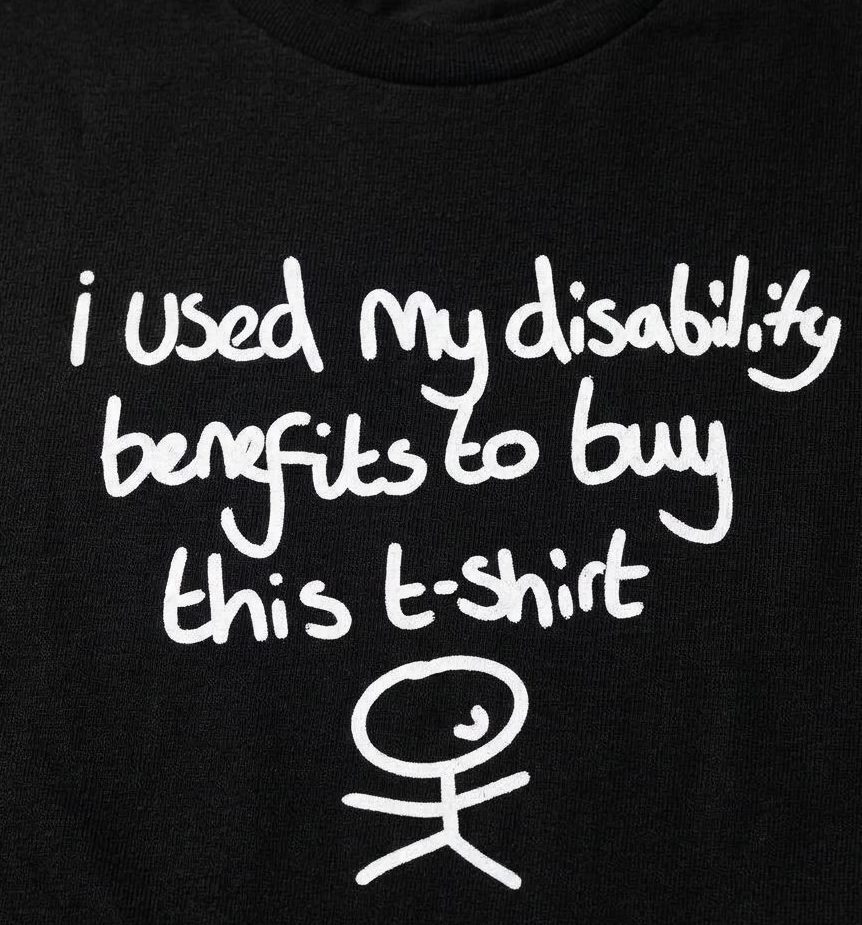
Everyone Benefits T-shirt
A little sarcasm for a debate that could do with a reality check. Because the benefits conversation works both ways.
Because if we’re going to be part of the conversation, we might as well bring a bit of sarcasm with us.
So when did basic workplace accessibility become a luxury?
Young disabled people should not have to choose between protecting their health and being treated as though they’re making a genuine effort.
They shouldn’t have to accept discrimination as a rite of passage into adulthood. They shouldn’t have to be grateful for inadequate adjustments. And they certainly shouldn’t be labelled lazy simply because the route into employment isn’t as straightforward for them as it is for someone else.
We can acknowledge that working life can be difficult without pretending that every barrier is inevitable.
We can encourage people to pursue opportunities while also expecting employers to make those opportunities accessible.
And we can stop confusing equality with special treatment.
Because the answer isn’t to tell disabled people to toughen up and accept the world as it is. The answer is to make the world of work fairer, more accessible and more inclusive in the first place.
How many more disabled people could be working if workplaces actually made room for them?
That’s the conversation I’d rather be having.
A Spoonful of Salt — disability humour for people who are tired of pretending everything is fine.